
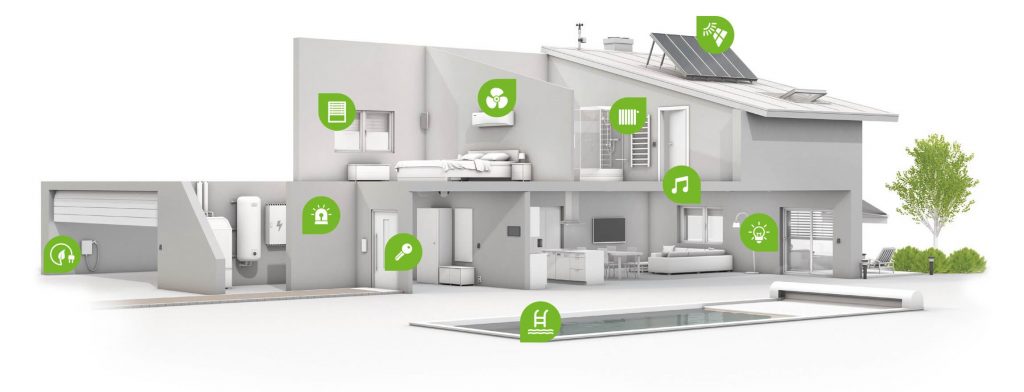
A Building Management System (BMS) as a computer-based control system installed in buildings will control and monitor the building’s mechanical and electrical equipment such as ventilation, lighting, power systems, fire systems and security systems.
A BMS consists of software and hardware; the software program, usually configured in a hierarchical manner, can be proprietary, using such protocols as C-bus, Profibus, and so on, recently, however, new vendors are producing BMSs that integrate using Internet protocols and open standards such as DeviceNet, SOAP, XML, BACnet, LonWorks and Modbus.
Hotel
Buildings
Successful hotel business depends on the level of service that you provide to your guest and it is still closely associated with ICT technologies implemented in your hotel. Intelligent hotel system raises the competitiveness of the hotel providing quality service to guests, enhanced security and cost savings across the business.
Accessibility of information everywhere and at any time is the request of today’s guest and to hotel a tool to increase sales of its own services. We belong to the circle of few companies that have a comprehensive portfolio of hotel solutions, which we are able to project and make operative with own resources.
All our solutions are integrated with leading suppliers of hotel software. Regardless if you are building a new hotel, renovating existing one or you want to introduce a new service, we have to offer you our solutions.
Healthcare & Hospital Buildings
Buildings provide space to work, live, learn, produce, sell, have fun, etc. Depending on the building’s use, the users have different requirements for heating, cooling, air conditioning and lighting. The intelligent building automation ensures an optimum indoor climate depending on the respective use. A comfortable building climate positively affects the well-being and productivity of users. Building automation links the existing systems and optimizes their interaction for maximum energy efficiency.
It automatically determines (for example, using presence detectors and sensors) the actual requirement for heating, cooling, fresh air, light and shade in the rooms and provides the energy in the right amount, at the right time, and in the right location. This type of needs-based building automation system prevents energy waste and results in a noticeable and worthwhile reduction in operating costs with swift repayment.
Residential & Commercial Building
Buildings provide space to work, live, learn, produce, sell, have fun, etc. Depending on the building’s use, the users have different requirements for heating, cooling, air conditioning and lighting. The intelligent building automation ensures an optimum indoor climate depending on the respective use.
A comfortable building climate positively affects the well-being and productivity of users. Building automation links the existing systems and optimizes their interaction for maximum energy efficiency.
The need-led control strategy in accordance with the suitable standards can be applied to every building, irrespective of the location, use, age, exterior, etc. It also makes the building capable of larger or smaller conversions and is easily adapted to changing requirements.
Using the audit methodology that, you can tap into the potential for optimization and save on energy costs. Continuous recording and tracking of the operating states reduces operating costs over the entire life cycle of the building.
Protocol Types
- BACnet: The ASHRAE BACnet (Building Automation and Control networks)
- LonWorks: Local Operating Network
- KNX: A worldwide communication standard for home and building control
- Clipsal C-Bus: Communication protocol based on a seven-layer OSI model for home and building automation
- DALI: Digital Addressable Lighting Interface
- Modbus: Serial communication protocol developed by Modicon
- M-Bus: Meter-Bus is a European standard for the remote readout of consumption meters (heat, gas, etc.) in homes and buildings
- OPC: A global software interface that enables the exchange of data among devices, control systems and applications.
- Web Services: Standardized way of enabling different applications and IT systems to interact via the Internet
- EnOcean: The EnOcean standard for wireless networking was originally developed as a commercial venture of Siemens AG.
- ZigBee: ZigBee is a wireless standard for home and commercial use developed by the ZigBee Alliance.